Vol. I · No. 1 Wednesday, November 11, 2026 Price: Two Cents

Ordinary Means

Theological writings from a seminarian's desk

Ordinary Means: Front Page

Cut Off From the Assembly

The Logic of Paul’s Wish in Galatians 5:12

Originally written for NT5150 - Greek Exegesis, Reformed Theological Seminary Jackson

A landscape photograph from the editor's collection

Longenecker calls Galatians 5:12 “the crudest and rudest of all Paul’s extant statements,” and the question is whether the wish interrupts the argument or completes it. The sentence reads ὄφελον καὶ ἀποκόψονται οἱ ἀναστατοῦντες ὑμᾶς, “would that those who are unsettling you would even be cut off.” The text is 5:12, the climax of the pericope 5:7–12 and Paul’s last word to the agitators before the exhortation of 5:13 begins. Verses 7–11 are read as the cotext that builds to it, and the unit 5:2–12 as the setting where its language of separation begins. The wish belongs to the pericope it closes and to a pattern that runs through the letter, in which those who impose the cut of circumcision are themselves cut off.

Continue reading →

The School of the Cross

Marriage as an Instrument of Mortification in Reformed Theology

Originally written for Introduction to Pastoral and Theological Studies, Reformed Theological Seminary Jackson

Modern evangelical accounts have recovered the conviction that marriage sanctifies, but without the doctrinal structure that once explained how. Marriage gives the universal command of self-denial a covenantal form. The Spirit uses faithful obedience to those Word-defined duties to mortify indwelling sin, and the Spirit uses the limits of marriage to redirect desire from the spouse to Christ. Read alongside Gary Thomas and Timothy Keller, and with Michael Allen’s dogmatic account of sanctification in view, the work of Calvin, Owen, Gouge, and Bavinck supplies an account of mortification and a structure of duty, together with an eschatology that contemporary treatments presuppose but leave less developed.

Continue reading →

Phanerow: The Church Digital Visibility Project

Making Your Church Known Online

Phanerow on a desktop and a phone: the Greek verb with its definition, and the intake form a session fills out
greatidea.dev

"For what can be known about God is plain to them, because God has shown it to them" (Romans 1:19, ESV). The verb there, ἐφανέρωσεν, is φανερόω: to make known. I have named a project after it.

Continue reading →

Hagiazomai

A Filter on Your Own Phone, and a Friend Who Gets an Alert

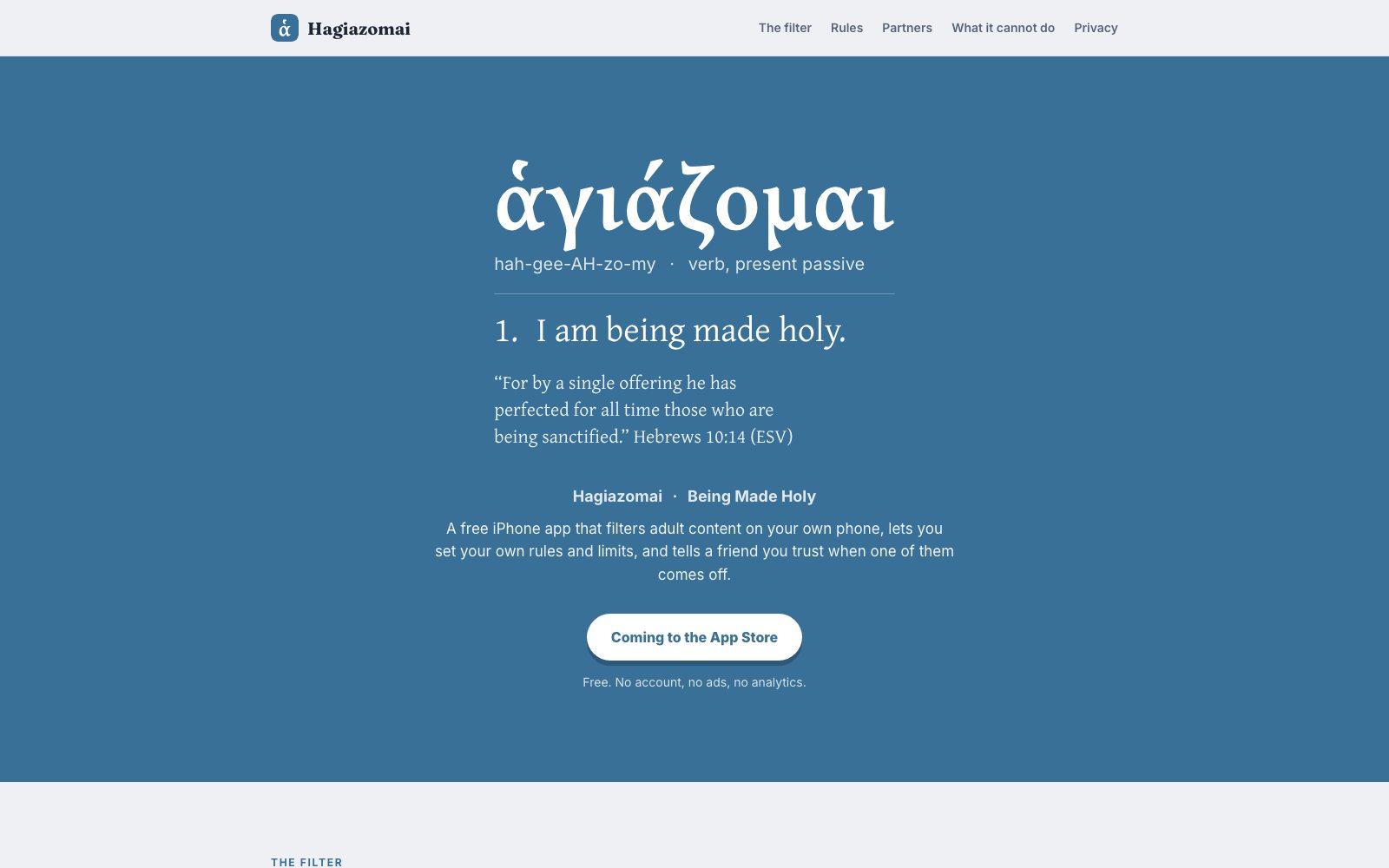
Hagiazomai's website, with the Greek word set out as a dictionary entry
hagiazomai.ordinarymeans.com

The letter to the Hebrews says of Christ, "For by a single offering he has perfected for all time those who are being sanctified" (Hebrews 10:14, ESV). The last words of that verse translate one Greek participle, and its first-person form is ἁγιάζομαι: I am being made holy. It is present, so the work is still going on. It is passive, so the work is done to me. The same sentence says that those people have already been perfected for all time by one offering. The believer stands between those two verbs, finished in Christ and not yet finished in himself.

Continue reading →

Katecheo

A Study Lock for the Mac and the iPhone

Katecheo's website, showing a Greek flashcard on a Mac and a lockout question on an iPhone
katecheo.ordinarymeans.com

Luke tells Theophilus why he wrote his Gospel: "that you may have certainty concerning the things you have been taught" (Luke 1:4, ESV). The verb behind "taught" is κατηχέω, to instruct by word of mouth. It is where the church gets "catechize." It names an old method: one person asks, the other answers, and the asking is repeated until the answer is known by heart.

Continue reading →