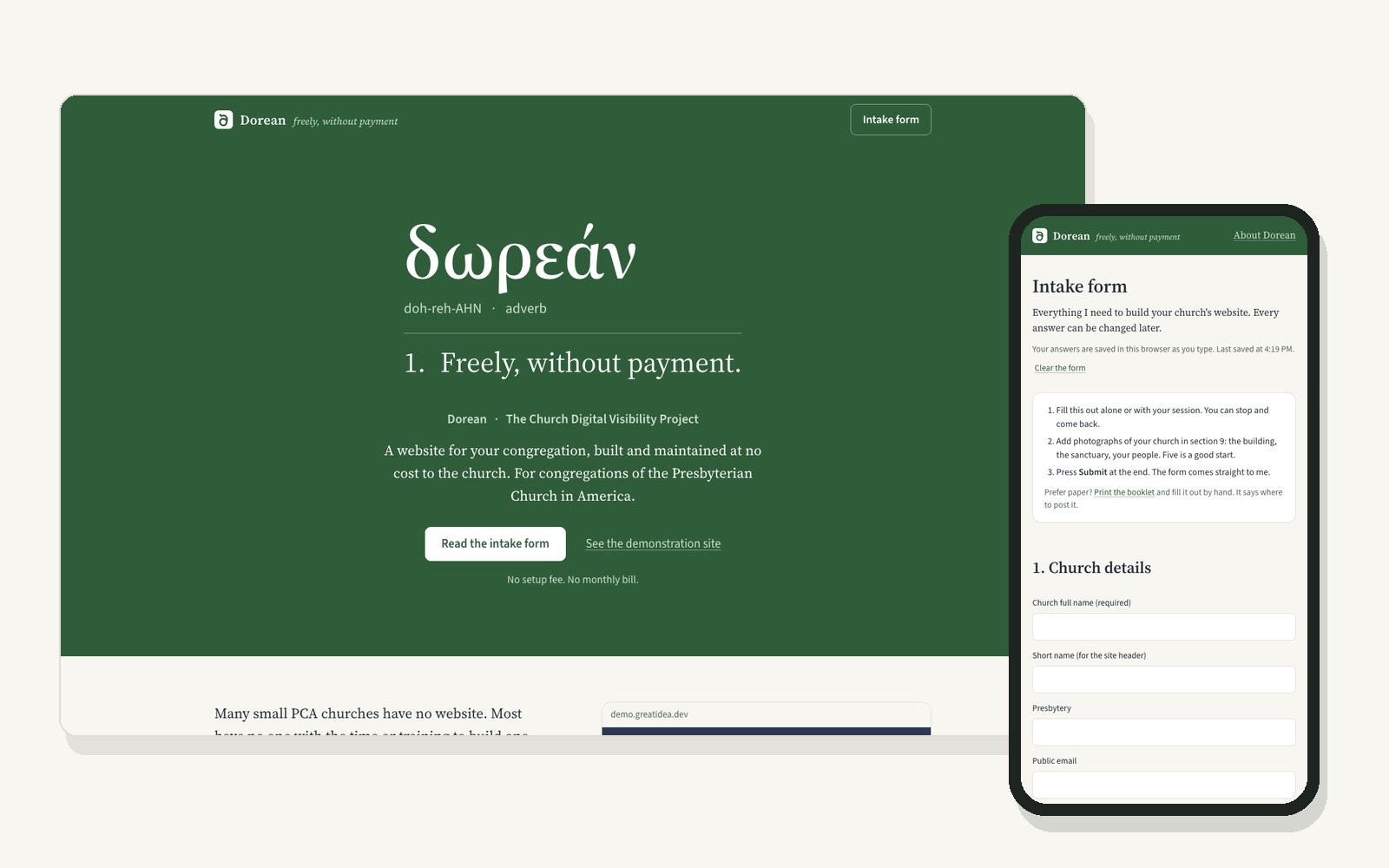
When Jesus sent out the Twelve, he told them what to charge for what they carried: “You received without paying; give without pay” (Matthew 10:8, ESV). Both halves of that sentence turn on one Greek word, δωρεάν, said doh-reh-AHN. It means freely, without payment, as a gift. Paul uses the same word for how a sinner is made right with God: “justified by his grace as a gift” (Romans 3:24, ESV). I have named a project after it, because the word says both what the project is and why it exists.
The Need
Many small congregations of the Presbyterian Church in America have no website. Most have no one with the time or training to build one, and the commercial services that sell church websites can cost more than a small church can reasonably spend. The result is that a family searching for a church in their town may never learn that a faithful one meets ten minutes away.
I am a member of Northpointe Presbyterian Church in Meridian, Mississippi, a full-time student at Reformed Theological Seminary in Jackson, and a full-time software engineer. When our church’s site needed replacing, I built a new one from scratch. It is live at northpointepca.org. It keeps an archive of more than 840 sermons that updates from the church’s YouTube channel, shows the calendar, and gives the church’s own people a simple panel for keeping it current.
That work took months. It seemed a waste to do it once.
The Offer
So I have turned it into a platform that other PCA churches can use, and I offer it at no cost to the church. That is Dorean. Northpointe is the model for it. A church’s site will look similar to Northpointe’s, though not exactly the same, and it can have many of the same features. There is no setup fee and no monthly bill. I pay for the domain and the hosting myself, and those costs stay small because every church shares one platform.
Everything I have in Christ came to me without cost. I also have a skill that small churches need and often cannot afford. So I offer it the same way, with nothing owed in return. I am not a company, and this is not a sales offer. It is one member of a PCA church serving other PCA churches with the work he knows how to do.
One Form
A church’s session fills out one intake form and I do the rest. The form asks for what a visitor would want to know and what only the church can decide:
- the church’s name, presbytery, address, and contact details
- service times and the weekly schedule
- the pastors, elders, and deacons
- a YouTube channel, if sermons are posted there
- which pages the site should have
- one of ten color themes
- the wording for the home, visiting, beliefs, and vision pages
- photographs of the church
The form can be filled out online, where the answers are saved in the browser as they are typed, so nothing is lost if the session stops and comes back. Photographs can be added to it, and it is sent with one button. A church without a printer or a taste for web forms can use the printed booklet instead, which asks the same questions and can be posted back.
On the wording, suggestions are provided, based on the Westminster Standards, and the session may use them as written, revise them, or replace them with its own. The session reviews and approves the whole site before it is announced, and it controls every word afterward.
One person in the congregation can keep the site current. An administrator and any editors sign in with an emailed code, with no technical training needed, and change service times, leadership, ministries, and the text of the pages.
What a Church Gets
A domain name, registered and renewed. A complete site: home, visiting, beliefs, vision, leadership, ministries, sermons, and contact. A sermon archive that updates from YouTube. Hosting, security updates, and repairs.
One feature uses AI, and it is labeled where it appears: an outline of each sermon with bookmarks into the recording. A church may leave it out. AI is not used for a church’s pages or its wording.
Photography, social media, and livestream production are not part of it.
How to Begin
A demonstration site for a fictional congregation, built on the platform, can be visited at demo.greatidea.dev. It shows what a church receives. Northpointe is my own church, so its site is tended separately and by hand, and it is where new features are tried first.
I do this alongside my work and my studies, so each site is set up personally, one church at a time.
If your church has no website, or has one that no one can update, the offer is described in full at greatidea.dev, and the form your session would fill out is here:
“But all things should be done decently and in order” (1 Corinthians 14:40, ESV). Paul wrote that about worship, not websites. But a church that keeps its doctrine and its worship in good order can afford to have its front door found.