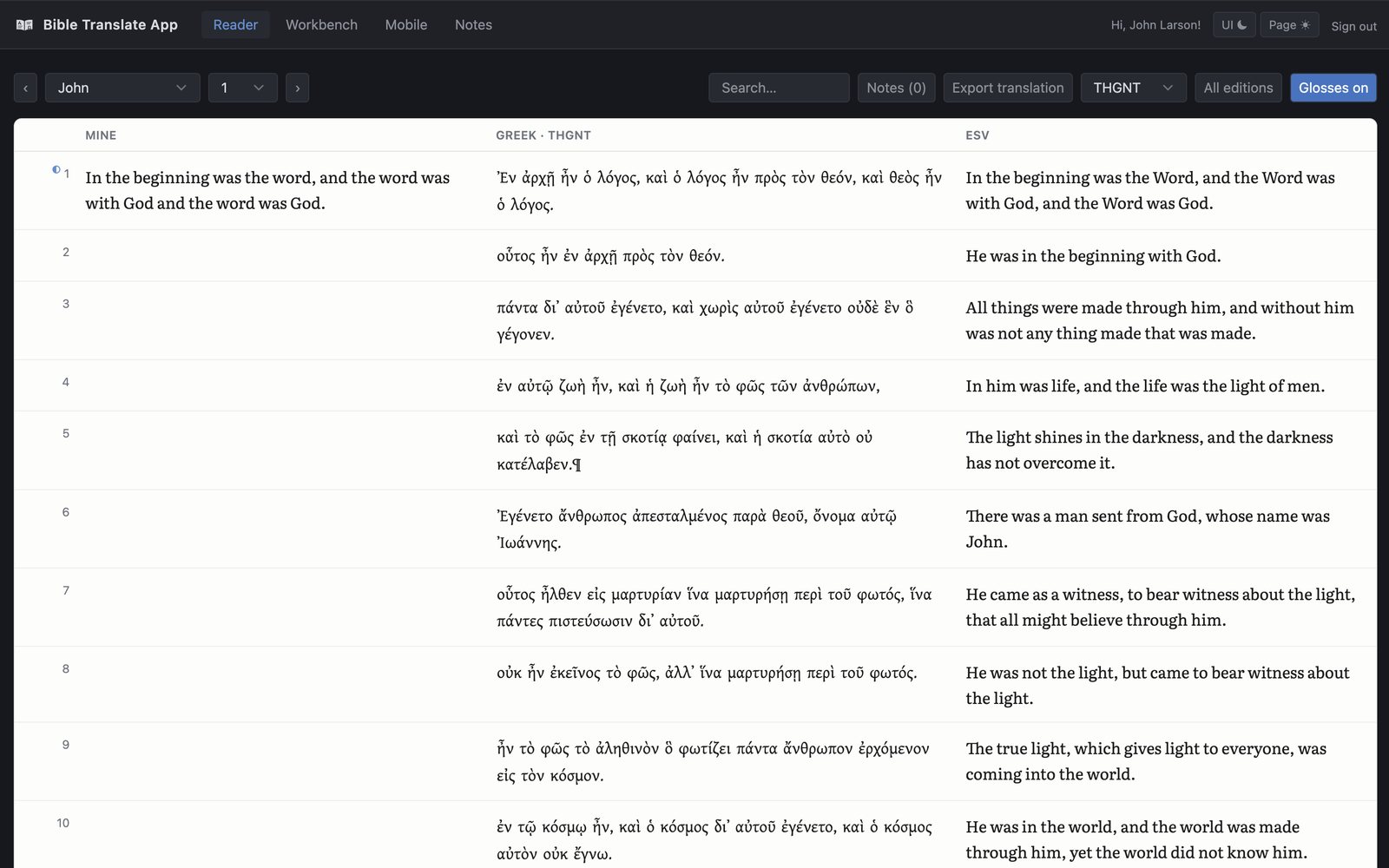
Anyone who has studied Greek with an English Bible open nearby knows the temptation. The eye drifts to the translation, the mind recognizes the answer, and it feels exactly like having worked it out. It is the feeling of translating without the labor of it, and the labor is where the language is learned.
Translate is the tool I built to take that crutch away from myself. It is a reader and a workbench for the Greek New Testament, and its one firm rule is that the English stays out of sight while the translating is being done.
The Workbench
The workbench shows the Greek text and an empty line for each verse. Nothing else is on the screen. There is no ESV in that view at all. Glosses for individual words exist, but they are turned off by default, and turning them on is recorded with the translation, so that later I know which verses I did unaided and which I did with help.
Every rendering of every verse is kept. If I translate Romans 1:1 today and again next year, both versions are there, with a word-by-word comparison between them. Nothing is overwritten.
The Review
When a passage is finished, it can be submitted for review. An AI model checks each verse against the Greek and its parsing, and returns a verdict with notes on what it found: a tense rendered wrongly, a case missed, a word left out.
The reviewer works under rules I wrote for it. It never supplies a translation of its own. It never compares my work to a published version. It does not offer praise. It is allowed to say that it has nothing to report. It is a checker of grammar, and I treat it as one. It can be wrong, and the lexicon and the grammar remain the authorities.
The Reader
The reader sets three columns side by side, verse by verse: my translation, the Greek, and the ESV. This is the place for comparing, once the work is done.
The Greek can be read in seven editions, including the Tyndale House text, the Nestle-Aland 28th, the SBL text, the Byzantine text, and the Textus Receptus. A combined view shows where the editions differ. Every word carries its lemma, its parsing, and a gloss. The Greek text and its tagging come from STEP Bible, and are used under a Creative Commons license.
Notes can be attached to any set of verses and searched later, and both notes and translations can be exported.
Scope
It covers the Greek New Testament, as a place to translate and keep notes rather than a study library with a lexicon, commentary, apparatus or scores; Hebrew and the Old Testament are planned and not yet built.
It was made for one student, and it is open to any other. Signing in takes an email address and a code sent to it, and your translations and notes are kept under your own account.