Paul could say that the Son was sent at a particular moment in the history of the world: “But when the fullness of time had come, God sent forth his Son, born of woman, born under the law” (Galatians 4:4, ESV). The faith is bound to dates. It has kings who can be numbered, an exile that can be placed on a calendar, and a governor whose name is in the creed.
The trouble for a reader is that the Bible does not tell this history in one line. Kings and Chronicles move back and forth between two kingdoms. The prophets are bound in a different part of the book from the kings they addressed. It is possible to read Isaiah for years without ever placing him beside Hezekiah, or to forget that Jeremiah and Ezekiel were alive at the same time, one in Jerusalem and one in Babylon.
I built the Biblical Timeline so I could see it all at once.
Four Eras
The timeline is drawn in four views.
Genesis to Solomon runs from creation to the death of Solomon. The earliest periods are placed for sequence only. From Abraham onward the dates are anchored to 1 Kings 6:1 and the early date of the Exodus.
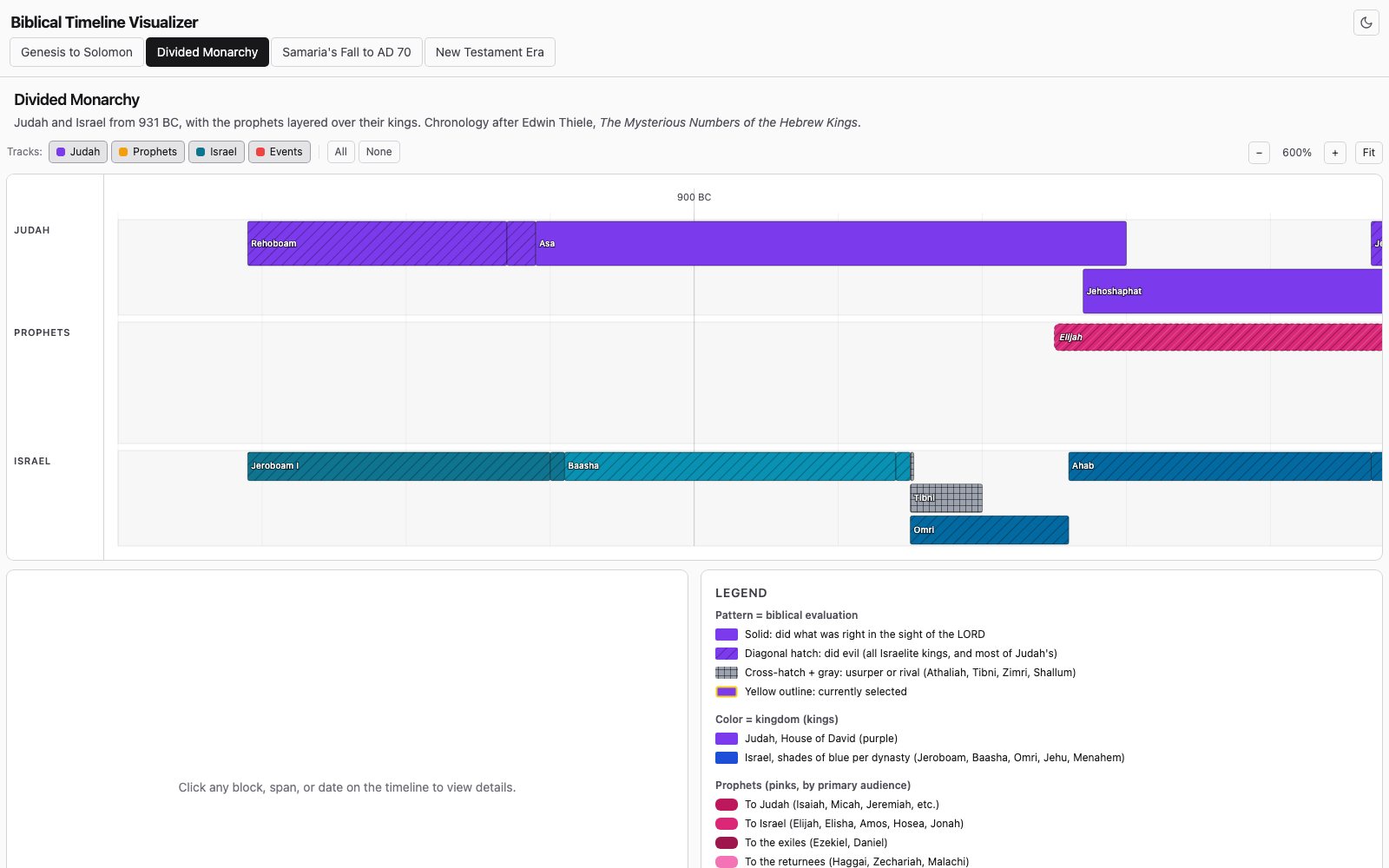
The Divided Monarchy begins in 931 BC and sets the twenty kings of Judah and the twenty kings of Israel in parallel rows, with the prophets layered between them. The chronology follows Edwin Thiele’s The Mysterious Numbers of the Hebrew Kings.
Samaria’s Fall to AD 70 runs from 722 BC to the destruction of the second temple. It carries the empires that ruled over the land, the last kings of Judah, the Hasmoneans and the Herodians, and the prophets through the return from exile.
The New Testament Era runs from 50 BC through the apostles and the first generations of the church after them.
How to Read It
Every reign is a block, as long as the reign was. A king whom Scripture says did what was right in the sight of the LORD is drawn solid. A king who did evil is hatched. That covers every king of Israel and most of the kings of Judah, and the page makes the point faster than a paragraph could: eight solid blocks out of forty.
The prophets are colored by the people they were sent to, whether Judah, Israel, the exiles, or those who returned. Selecting any block, span, or date opens its details, with notes and Scripture references.
The rows can be switched on and off, and the scale can be drawn in or out, from a whole era on one screen to a single decade.
A Word on the Dates
Biblical chronology is a field with real disagreements among faithful scholars, and a timeline has to choose. This one names its choices on each page so that they can be weighed. Where a date is approximate, it is marked as approximate. It is a study aid for seeing the order and overlap of things, and the text of Scripture remains the authority over every block on it.
It is free, with no account, and it works on a phone.